If you’ve spent any time following major collectible auctions, you’ve probably noticed a disconnect between the price an item “sold for” and the amount a buyer actually pays. That gap almost always comes down to one thing: the buyer’s fee.
Behind nearly every professional auction result is a hidden surcharge that quietly reshapes what collectors actually pay and how true market value is determined. It's called the buyer’s premium (BP), and understanding it is essential if you want to interpret auction results accurately, bid intelligently, or value your collection correctly.
The buyer’s premium is a fee added to the hammer price (the final bid) after you win an auction. If an auction house charges a 20 percent premium and the winning bid is $1,000, the buyer doesn’t pay $1,000. They pay $1,200. And that's before tax, shipping, or any additional fees. That extra amount goes directly to the auction house and is now a standard feature of nearly every major collectible auction worldwide.

While buyer’s premiums can feel like a modern annoyance, the idea itself is anything but new. Auction-style sales date back thousands of years, and historical records have suggested that even ancient Roman auctions included buyer surcharges. The modern buyer’s premium, however, took its current form in the mid-1970s, when leading London auction houses like Christie’s and Sotheby’s introduced a standardized percentage added to the hammer price. At the time, the rate was roughly 10 percent.
That change marked a major shift in how auctions worked. Before buyer’s premiums became common, auction houses primarily made their money by charging sellers commissions. But as competition for top-tier consignments increased, especially for rare and high-value items, sellers began pushing back. Auction houses needed a way to remain profitable while offering more attractive consignment terms. The solution was to share the cost of doing business between sellers and buyers.
That structure is now deeply embedded in the auction world, and perhaps no company illustrates it better in action for our audience than Heritage Auctions.
Heritage Auctions is the largest collectibles auction house on the planet, handling everything from comics and cards to coins, art, and historical memorabilia. Operating at that scale requires enormous investment: expert cataloging, authentication, photography, global marketing, bidding platforms, logistics, and specialized staff across dozens of categories. Buyer’s premiums help fund all of it.
Just as importantly, a buyer’s premium allows an auction house like Heritage to attract larger, more important items for sale. By shifting part of the fee burden from sellers to buyers, Heritage can offer more competitive consignment terms. That matters enormously when a seller is deciding where to place a six or seven-figure collectible. Lower seller commissions make public auction more appealing than private sale, which in turn brings better material into the open market.
For buyers, that structure may increase the final invoice, but it also creates stronger auctions. More elite material leads to deeper bidding pools, clearer price discovery, and more reliable market data. The buyer’s premium is one of the mechanisms that makes top-tier auctions possible in the first place.
This is where collectors often make a critical mistake. Many people focus exclusively on hammer prices when researching past sales. They see a comic “sell for” $100,000 and mentally anchor to that number. But no buyer actually paid $100,000. They paid the hammer price plus the buyer’s premium. That total -- often referred to as the price realized -- is the real market transaction.
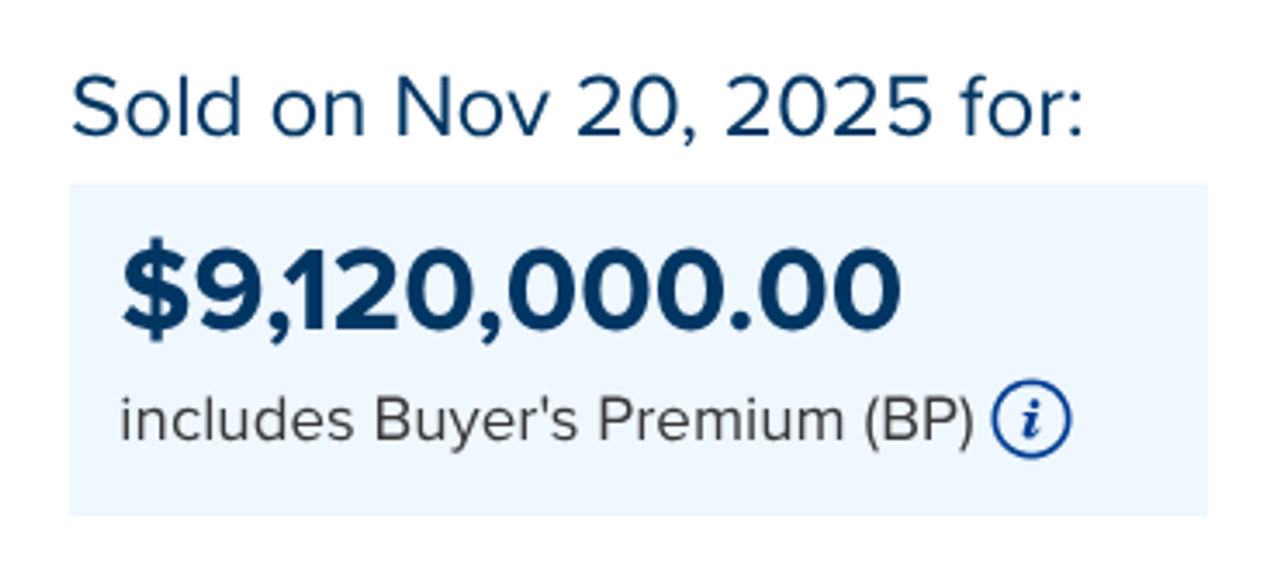
This distinction is so important that Heritage’s own appraisal department emphasizes that fair market value should always include the buyer’s premium. Serious collectors, appraisers, and even your insurance institutions don’t rely on hammer prices alone because hammer prices understate what buyers were truly willing to pay.
At GoCollect, this principle is foundational. When we calculate Fair Market Value, we don’t just look at what an item “hammered for.” We incorporate buyer’s premiums into our data because that reflects real-world behavior. FMV should represent the price at which a willing buyer and a willing seller transact in an open, competitive market; and that transaction includes the premium.
Ignoring buyer’s premiums leads to distorted conclusions. It makes bargains look better than they were and market growth look flatter than it actually is. It can also cause collectors to under-budget when bidding or overestimate future resale potential. Respecting the premium, on the other hand, allows collectors to compare values across time, venues, and categories.
This is especially important in markets where Heritage Auctions serves as the primary price leader. They were used in this article because their realized prices are widely cited, their record sales set benchmarks, and their data heavily influences private transactions. Understanding how buyer’s premiums factor into those results is essential for anyone using auction comps to make decisions.
Clarification:
If you are making those decisions using GoCollect, know that the buyer’s premiums do vary widely by venue, and that can definitely impact perceived FMV. When we ingest sales data, we use the realized price as reported by the venue itself, including whatever buyer’s premium applies in that specific case. We don’t normalize, adjust, or select a preferred percentage, and we don’t create data to fit any particular premium. The number shown on our pages is simply the final realized price reported by the source.