Pokémon celebrates it's 30th anniversary with top-tier sealed games and a Piece of TIME Magazine History
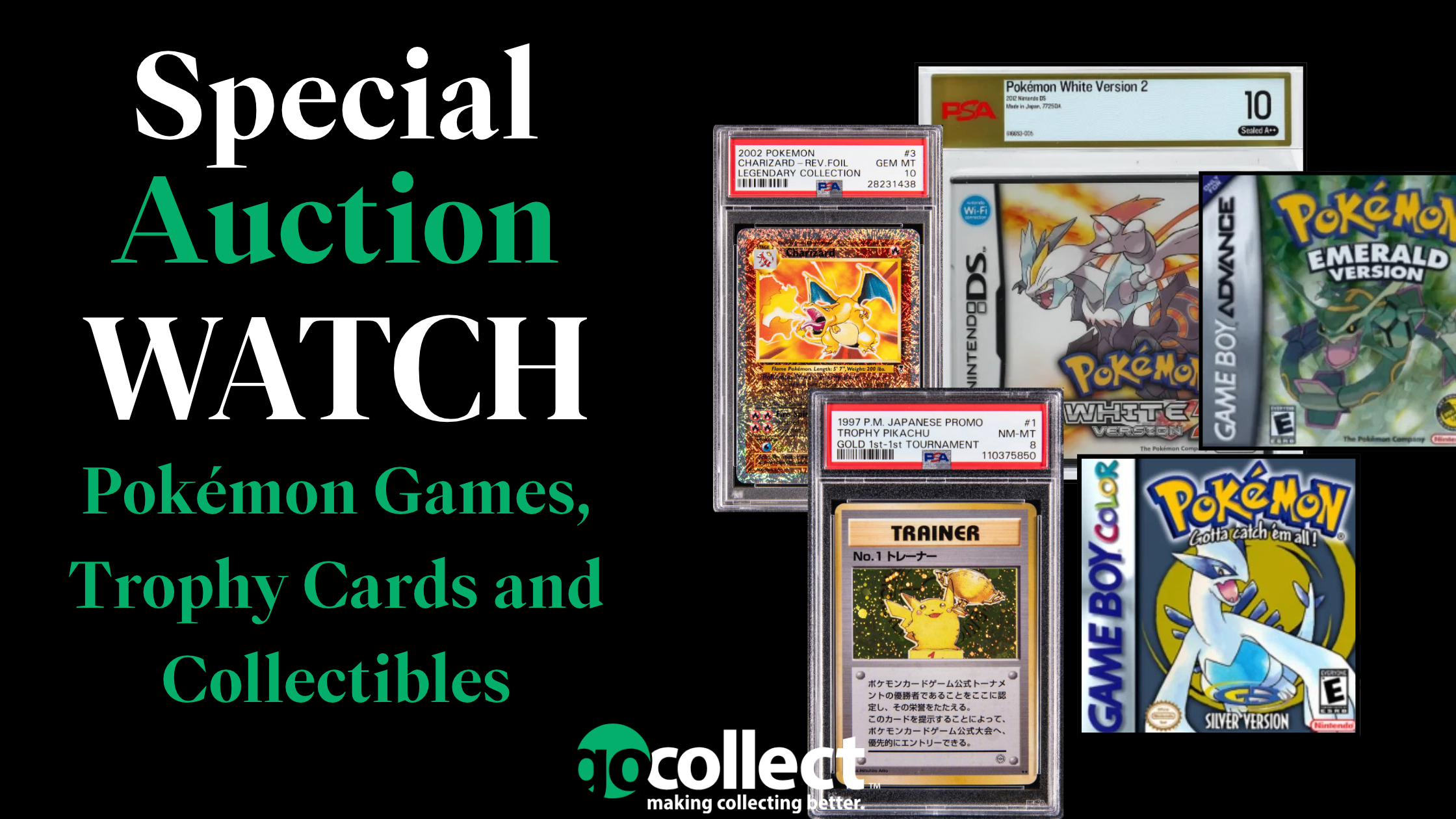
Pokémon collecting extends well beyond trading cards. Sealed video games, early production variants and high-grade magazine covers are attracting buyers across multiple categories, with Goldin’s 2026 Pokémon 30th Anniversary Auction bringing several of these collectibles into the same marketplace.
The current auction includes every game spanning from the original Game Boy releases to the Game Boy Color versions, the Advance, and through to the Nintendo DS, alongside 2 copies of the November 22, 1999, TIME magazine cover featuring Pokémon. The listings offer a look at how collectors approach sealed condition, production differences, grading populations and the franchise’s place in popular culture.
View the auction listings here while you read along.
Game Boy Advance: Emerald leads the video game listings
Pokémon Emerald is the headline game at the moment in this group, obliterating all historic recorded values for this release. Goldin’s Lot #75 is an early-production, sealed 2005 Game Boy Advance copy graded PSA 9.8/A++, with the Made in Japan designation and “Only For” logo. The live bid has reached $65,600, or $80,032 including Goldin’s 22% buyer’s premium, with 46 bids reported in the latest indexed auction grid. The auction remains open, so this is not a final sale price.
Emerald was an enhanced version of the third-generation games, expanding on Ruby and Sapphire with additional content, including the Battle Frontier. Its standing among serious collectors reflects both the game’s popularity and the demand for sealed copies in high or top grade. The specific packaging and production details make this example more useful as a reference for specialist collectors than as a direct valuation for every sealed copy of Emerald.
Pokémon FireRed is another notable GBA entry. Lot #76 is also an early-production copy graded PSA 9.8/A++, with Made in Japan/Philippines printing details and the wireless-adapter “Adapater” misprint. Goldin’s listing shows a $19,500 bid, or $23,790 with the buyer’s premium, with 10 bids reported.
FireRed and its companion title, LeafGreen, were enhanced remakes of the original Red and Green/Blue-era games. Their appeal combines the original Kanto adventure with later hardware and gameplay improvements. For sealed-game collectors, the distinction between standard copies and a high-grade early-production example can be significant.
Pokémon Sapphire and Pokémon Ruby are also included in Goldin’s auction. The Sapphire listing is a sealed Made in Japan copy graded PSA 9.8/A+, while the Ruby listing is a sealed Made in Japan copy graded PSA 9.8/A++. These titles established the Hoenn region and introduced the third generation of Pokémon. Their current live bids are $14,945 and $40,870 respectively.
LeafGreen is represented by a high-grade, sealed early-production example with the same “Adapater” misprint noted on FireRed. Its current high bid likewise represents this early identifier. It sits at $19,642 with 16 bids.
Taken together, the GBA titles demonstrate why sealed video games should not be compared by title alone. Grading, seal quality, manufacturing details and packaging variations can materially affect the desirability of an individual copy.
Nintendo DS: White, White 2 and Black 2
Goldin’s DS offerings include Pokémon White Version, Pokémon White Version 2 and Pokémon Black Version 2. All three are sealed games graded PSA 10/A++, but their production details and census information differ.
White Version, released in 2011, is identified as a Made in Japan example with production code 73329A. White Version 2 and Black Version 2, both released in 2012, are listed with Made in Japan production codes 777250A and 777244A, respectively. Goldin’s listing identifies White Version 2 as a first-print example with a population of one and Black Version 2 with a population of two when the listing was prepared.
The two sequels warrant separate consideration from the original Black and White releases. They are distinct games, not alternate packaging of the same title, and sealed examples in top grade appeal to collectors completing a generation or targeting scarce production variants.
A high grading population is not, by itself, proof of future appreciation. The number of graded copies, the quantity actively offered, completed auction results and buyer demand all contribute to market value. Current bids for the three DS listings all hover around the same $2500-$3000 mark, and should be expected to grow before live bidding commences.
Game Boy: Pokémon Yellow and the PSA-Graded Red
Pokémon Yellow: Special Pikachu Edition typically sits in its own lane. Goldin is offering multiple sealed examples with different production details and grades in this event. Noteworthy here is a U.S. second-production PSA 10/A++ (Made in Japan, no rating on packaging, population of one at listing). Another is a first production example with the pixelated rating graded PSA 9.4/A++. A separate WATA 8.0/A+ also appears. These are not interchangeable items/valuations. As video games enter what appears to be a re-evaluation from serious collectors and investors, these production details matter more than ever.
Also in the mix is a is a first-production sealed 1998 Pokémon Red Version graded PSA 9.4/A++ (Made in Japan, pixelated E rating, H-seam, Sandshrew screenshot). Live bidding has reached $41,480 with 17 bids recorded. Red remains foundational - the game that helped launch the franchise internationally - so high-grade sealed first-production copies carry real weight for collectors who want the origin story in original packaging.
Game Boy Color: Gold, Silver and Crystal
The Game Boy Color listings include Pokémon Gold, Pokémon Silver and Pokémon Crystal.
Gold and Silver introduced the Johto region and the second generation of Pokémon. Crystal followed as an enhanced version of that generation, adding its own features and presentation. All three titles have a place in the franchise’s collecting history, but the individual examples offered at auction here differ in grade and production characteristics.
The Silver listing is a sealed Made in Japan copy graded PSA 9.8/A++ and is poised to break its own record value. Gold is represented by a sealed Made in Japan example graded PSA 9.4/A++. Crystal is a first-production, Made in Japan copy graded PSA 9.4/A++, with an H-seam and series-corrected details identified in the listing.
These differences are important when comparing auction performance. Silver’s higher grade cannot be isolated from other important factors, including minor production details that would distinguish this as a first production or a later release, as well as the number of comparable copies available. Crystal also deserves separate analysis rather than being treated as a substitute for Gold or Silver, as it is a confirmed first production.
The current live bids for these three listings should be independently confirmed from the accessible auction data, as the indexed prices are constantly trajecting upwards as time moves quickly towards live bidding.
TIME magazine: Pokémon’s first cover
The video game listings are accompanied by another piece of history from a completely different category: the November 22, 1999, issue of TIME featuring Pokémon and Pikachu.
Goldin’s final lot in the auction, #366, contains the highest graded U.S. subscription edition (by both CGC and PSA), graded at CGC 9.6. The listing describes it as a population of three with none higher at the time it was prepared. Its current bid is $1,098 with the 22% buyer’s premium, with 9 bids reported on the accessible listing.
A separate U.S. newsstand edition of the same issue, graded CGC 9.4, sold at Goldin on August 31, 2026, for $46,500 before premium, or $56,730 including the buyer’s premium, after 89 bids. That is a completed sale, but it is not a direct comparison with the current subscription copy: the edition and grade differ. What we have determined since we began tracking high-profile collectible magazines is that a possible comp may be found at roughly 5-8% of the newstand release. We're awaiting the finish of this particular magazine for closer a examination of that potential threshold. For reference, the last Subscription Edition sale recorded was a CGC 7.5 that sold for $2,800 on eBay earlier in October.
There is also an Australian Edition being offered in a CGC 9.2. Only one Australian Edition sale has ever been recorded, but the demand remains strong. A CGC 9.4 finished at Goldin over 2 years ago for $2,769.
The cover documents Pokémon at a pivotal point in its international rise. By late 1999, the franchise had expanded from video games and trading cards into toys, animation and film. The TIME issue is therefore a cultural artifact as well as a magazine collectible, capturing how Pokémon was being discussed by mainstream media at the height of its early expansion.
For magazine collectors, first-cover appearances can function much like rookie cards: they record an important public milestone in a recognizable format. Edition, grade, scarcity and condition remain central to valuation, especially when comparing subscription copies with newsstand examples, along with the increasing number of international copies now surfacing for certain publications.
What the auction shows
Goldin’s auction spans the Pokémon collectibles market’s full price spectrum, from its most expensive offerings to its most accessible entry points. There are a few hundred trophy cards available at this auction, sealed games from multiple Nintendo generations including production-specific packaging variants for you to choose your level of engagement, and the magazine cover that records the franchise’s mainstream arrival.
The heavier trading cards were omitted from this article due to the heavy publicity they receive naturally. Keep in mind while browsing items that these are all live auction snapshots, and not yet final prices.
The broader lesson to be learned after 30 years is that Pokémon collectibles do not form one uniform market. A sealed game, a rare packaging variant and a high-grade magazine cover have different supply profiles and attract overlapping but distinct buyers from standard TCG collecting. Any meaningful market comparison must begin with the exact item, edition, production details and grade, then use verified completed sales to establish a trajectory.
This auction closes on October 25th at 7pm.