WHAT'S INSIDE:
-Michael Jordan leads the charge in collectible magazines
-1st appearance collecting in non-sports cards creates a formula
-Early video game grails go for massive money
-Hard analysis on Absolute Batman
-Secret Wars has been giving clues all along
Michael Jordan has unofficially re-entered and began dominating the basketball court again. He may not be playing in any games, but you wouldn’t know that by the way his youthful face is outselling every other professional athlete on the planet on newsstands over the past 6 months.
His return to glory is part of a larger shift in the collectibles landscapes, where vintage magazine collecting is transforming the entire hobby into a larger, and in many cases, a more accurately dated trading card.
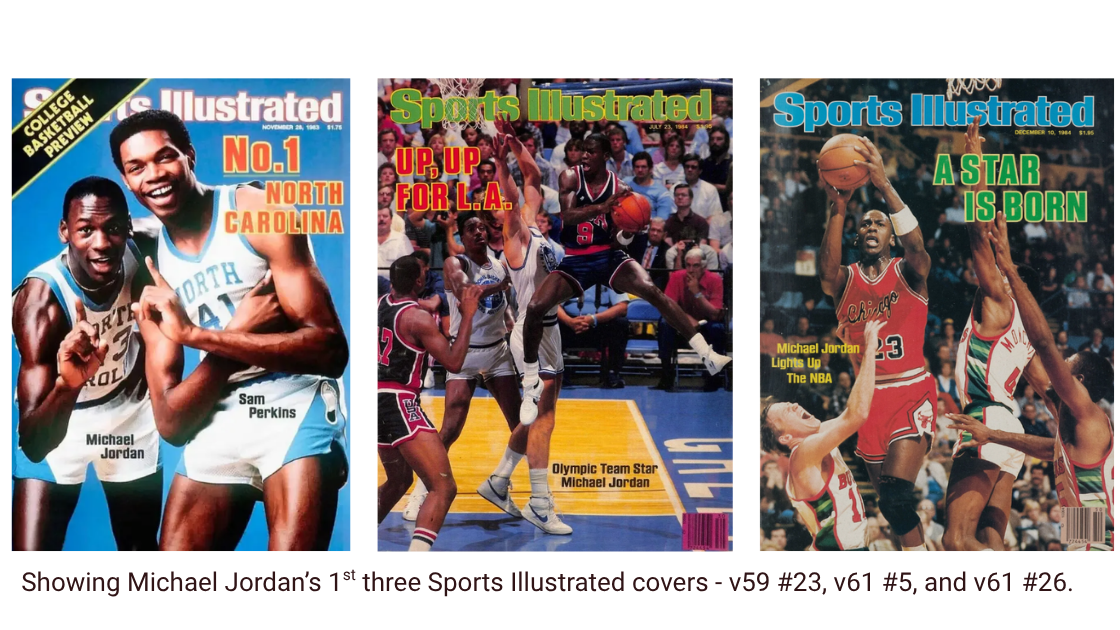
Collectors have returned to their hunt for firsts. It was inevitable that iconic fictional characters like Batman and Spider-Man would lead the way as comics are repositioning themselves for a spike, but to see real-life icons like MJ branding an emerging collectible hobby like vintage magazines - takes this conversation for a spin on its head. What makes this case extra special is that Michael has a collector-accepted trifecta of FIRST Sports Illustrated covers that ultimately culminates with his 3rd appearance in volume 61 issue #26 as his Chicago Bulls 'rookie' issue. Which means that his 1st 2 covers (shown above v59 #23 & v61 #5) are pre-rookie status, and both magazines pre-date Michael Jordan's earliest known rookie trading cards. This is a fact the public is beginning to invest in.
They say the trading card market is the trusted barometer of how ALL collectibles are behaving. Analyzing the current behavior of the card market, one would be safe to assume then that we are on the forefront of a goldrush for first appearances - and it doesn’t matter who or what you are now that vintage magazines are an established piece of the pie.
Every time I refresh our sales page I am inundated with first or very early print appearances of everything from Harry Potter to the Simpsons, Muhammad Ali, the Superbowl, Super Mario, Marilyn Monroe, and every other celebrity or franchise you can think of. It tells us that collectors are increasingly assigning value to objects because of where they sit in a cultural timeline - not simply because they're old or already established as a collectible item.
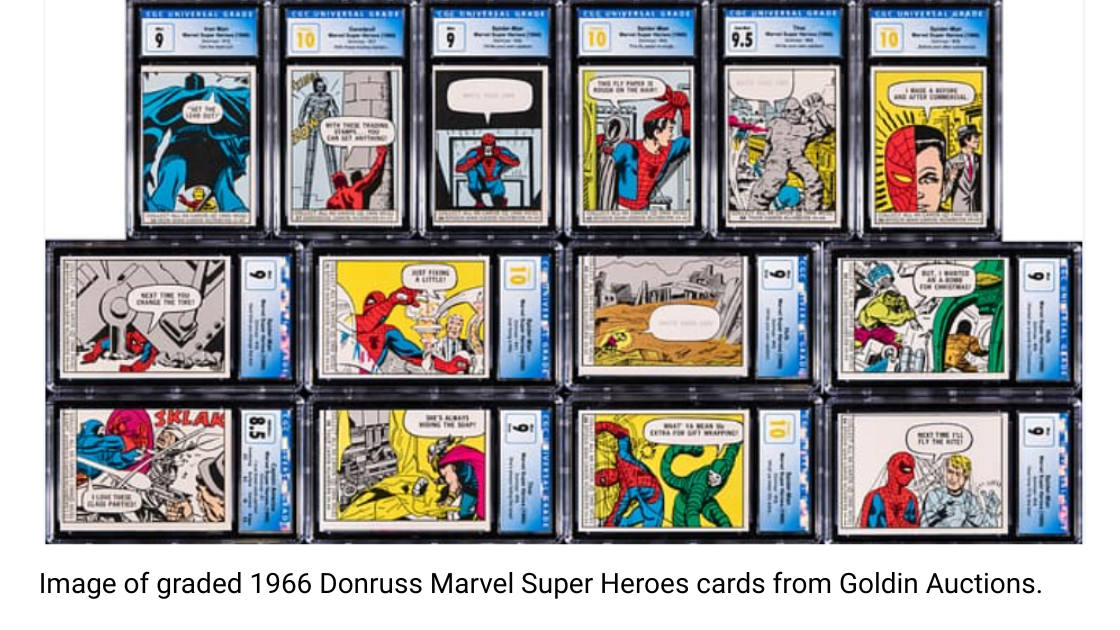
It would be just as easy to feel overwhlemed with the sale prices of first appearances in the non-sports card / pop culture crossover market right now. Particularly using the 1966 Donruss Marvel Super Heroes set as a prime example. We might as well throw in the 1966 Donruss Batman set also. There are some crazy outliers in recent sales from these sets. I'm using the term outliers because the recent sales are not representative of the set as a whole, but demonstrative of how thin the high-grade market can be when it sees something it likes.
It should be noted that it's moreso the cards that are the outliers in the conversation - we're talking first trading card appearances of Spider-Man and Batman - and the sales values themselves may be indicative of the new norm. Time will show us. One important wrinkle to note: #34 is arguably the first Spider-Man card in the set, but only due to sequencing (the entire set was printed and released at the same time). While #36 is the most valuable Spider-Man card based on the high-grade market. That distinction makes a great talking point for our “firsts” thesis. It touches upon the much broader definition of first at play here, and potentially creates a much richer way to hunt for overlooked magazine and trading-card collectibles.
A first is simply the first recorded appearance of something in a particular cultural record - that's all. When it comes to trading cards, every first is merely a tiny imprint of something that came before. Recent high sales for other brand names like Darth Vader, Mickey Mouse, Taylor Swift, and Elvis Presley reduce the definition ever further to 'first meaningful collectible record of a cultural icon'. All of a sudden there are a lot of fascinating cases.
This First & Foremost formula is expanding beyond trading cards and is now merging with a hobby that has historically been much more focused on condition, celebrity, photography, cultural importance, and cover appeal. The results have been dramatic for everything and everyone that falls under these conditions:
The first time a person appeared on a major magazine cover:
Sports Illustrated v96 #16 - 1st Tom Brady cover. 28 sales, 148 graded.
A PSA 9.6 sale a few days ago for $4,500 is 4x the amount a CGC 9.6 last sold for one year ago.
The first cover after a career-changing event:
Time Magazine v151 #24 - Michael Jordan retires. 26 sales, 162 graded.
A CGC 9.4 sale in July for $315 more than tripled the value of the previous sale in that grade.
The first national cover:
GQ Annual Sports Issue - 1st Erling Haaland national cover. 2 sales, 26 graded.
This guy popped onto our radar watching the World Cup and already has sales in 2 grades. Rising stars catch on fast in modern collectibles.
The first appearance of a character outside comics:
Animation Magazine #1 - Simpsons cover predates TV premiere by over 2 years. 1 sale, 32 graded.
The lone graded sale was a CGC 7.5 that auctioned for $153 last year. Available copies of this book on the current market are much higher in value.
The first issue of a long-standing publication:
Playboy v1 #1 - 1st issue of Playboy magazine. 166 sales, 432 graded.
3 9.4’s sit at the top of the CGC census. The last time one sold was 10 years ago for $71,700. Any thoughts on where that would sell today?
The first issue to feature a technology, cultural movement, actor, athlete or artist:
Bitcoin Magazine #1 - Bitcoin enters the mainstream. 31 sales, 301 graded.
The last sale was a CGC 3.5 for $750. When 1 of the 2 10.0’s trades hands we’ll be looking at a 5 or 6-figure deal.
The first major interview:
Sports Illustrated #v86 #16 - Tiger Woods talks after winning the Masters. 23 sales, 108 graded.
A CGC 9.6 sold for $815 in May, and there are 9 graded higher at a 9.8.
The first appearance of an image that subsequently became culturally iconic:
National Geographic #v167 #6 - Afghan girl photo cover. 5 sales, 26 graded.
A PSA 7.0 sold for $650 at the end of May, which nearly triples the value an 8.0 received at the start of 2026.
These are any of the requirements which essentially creates the magazine equivalent of a rookie card. We see them sell every single day from a new specific date in time - another first for humankind. To be clear - we are essentially talking about collecting raw history at this point.
Imagining how far this New Histori-cana trend will seep in to popular culture collecting is incomprehensible.
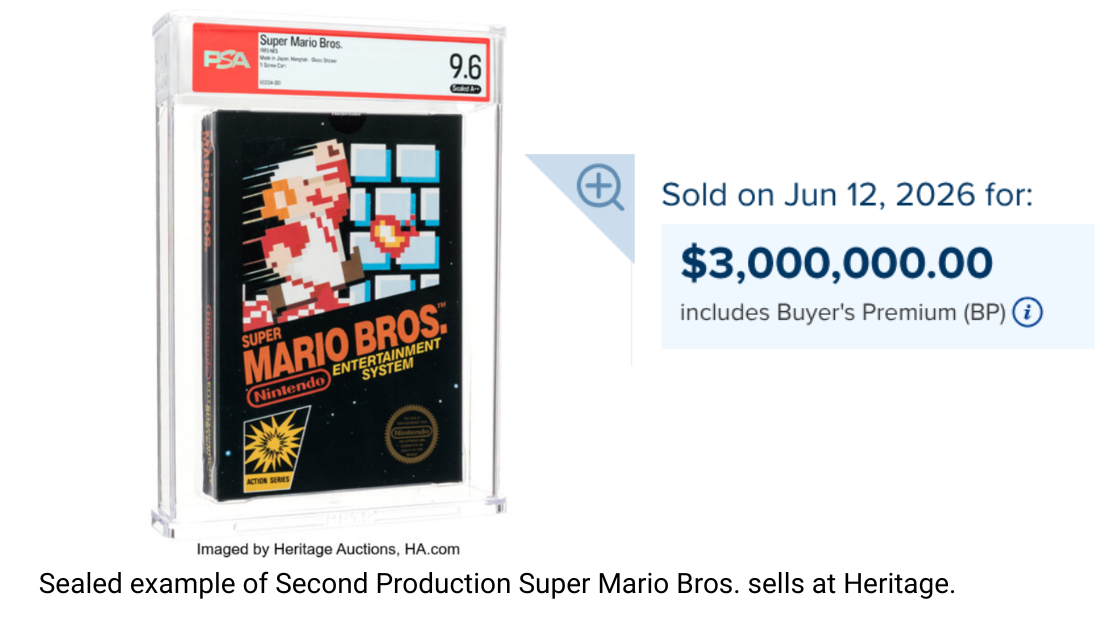
We're seeing some of that action take place in video games right now as well, where culturally significant items at the very top of the population are commanding higher premiums again. Take this sale of a Second Production sealed copy of Super Mario Bros. for $3,000,000 dollars less than 3 months ago at Heritage Auctions.
We've never seen a public sale of a higher graded sealed copy from an earlier production run. Same thing for this copy of Super Mario Land for the Game Boy. It is possible that PSA rebranding the WATA name has a lot to do with this new spark of interest in video game grails, which in turn is drawing out items from collectors that otherwise would remain buried. Combining this with the ubiquitous demand the public has for firsts gives the impression that we may be witnessing this hobby as well on the forefront of an increase in attention too, and what almost always comes with that attention is an increase in value.
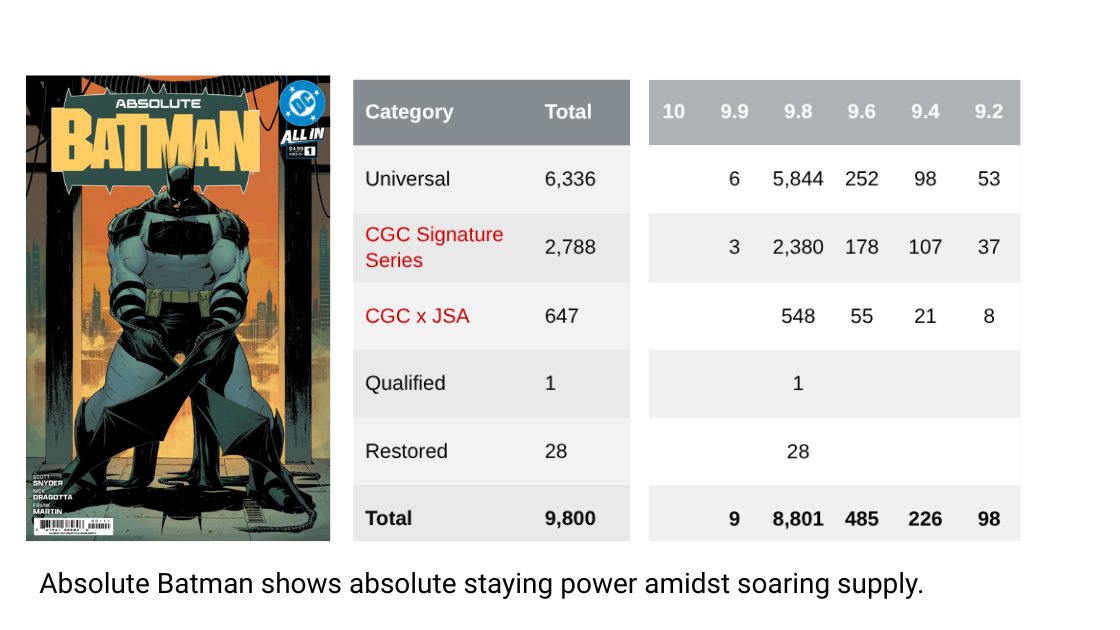
Finally, what we are seeing in comics over the past several months is a continuation of this overall trend, but we are seeing it in examples that are distinctly NOT low-supply books. Take the obvious case of Absolute Batman #1 (cover A), a unicorn example of demand outpacing an expanding supply curve: despite a rapidly growing census and an enormous underlying print run, transaction volume has increased alongside price, showing that buyers are absorbing new inventory rather than allowing supply to cap value. This will prove to be an extremely useful future case study in whether a modern comic book can develop price appreciation without sacrificing liquidity.
This also makes its appreciation fundamentally different from a scarcity-driven spike. The key metric going forward isn't simply census growth or FMV, but whether new copies are being absorbed by buyers quickly enough to keep the typical selling price moving higher: if supply continues expanding while volume and price remain elevated, Absolute Batman is demonstrating genuine demand density; if listings rise while sales velocity and median price deteriorate, the supply overhang has finally overwhelmed demand.
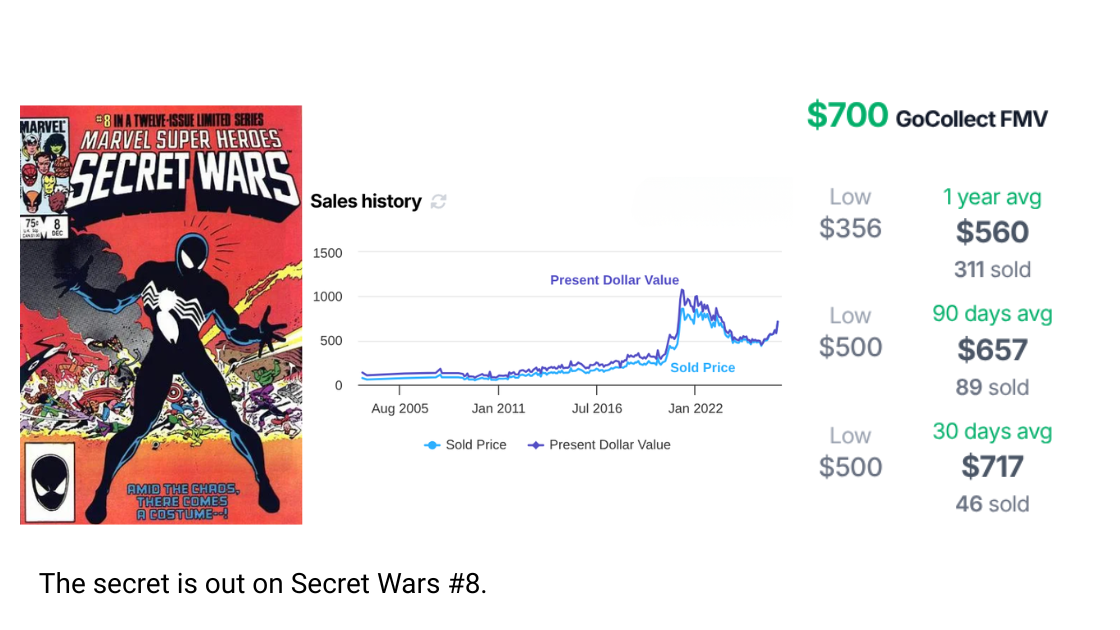
And what can we discern about it all from a black & white suit? AB1 isn't entirely unique once you factor in that Secret Wars #8 has been proving the same formula correct but adding a necessary sprinkle of what collectors truly love - a genuinely older print date. SW8 has been silently moving the entire time all of these other events have been transpiring. With Doomsday and the aforementioned Secret Wars movies ahead, we're watching key comics respond to renewed interest in Marvel.
What's more, this black and white personification perfectly sums up all of the cross-hobby events we are witnessing in relation to firsts. If cards are the barometer of the collectibles market, then comic books may be the pressure system that moves it. In this particular book (same as AB1) we see no true first appearances of anything except for a change in costume and a change in attitude. In pop culture terminology we would say that 'Papa's got a brand new bag'. And in turn, so do the collectors.
What you'll find in a lot of these new bags are the hunt for the first documentation of a cultural inflection point. Find the moment the weather changes, and you may have found the collectible everyone else is still waiting to see. Suit up.
We'll return later this week with a closer look at some of the trends proposed here, and fresh observations about the collectibles market.